
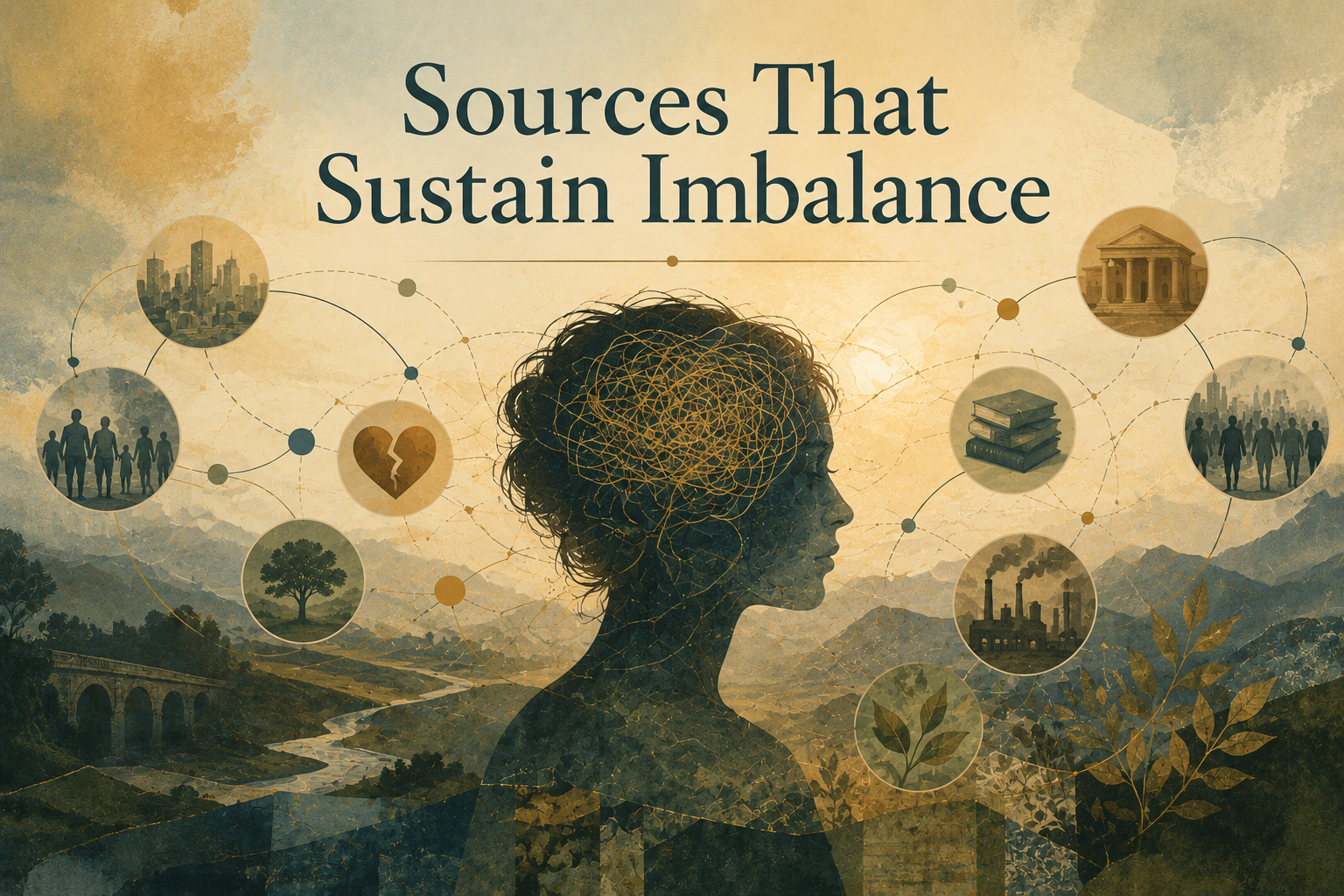
The Roots of Disconnection and Distortion
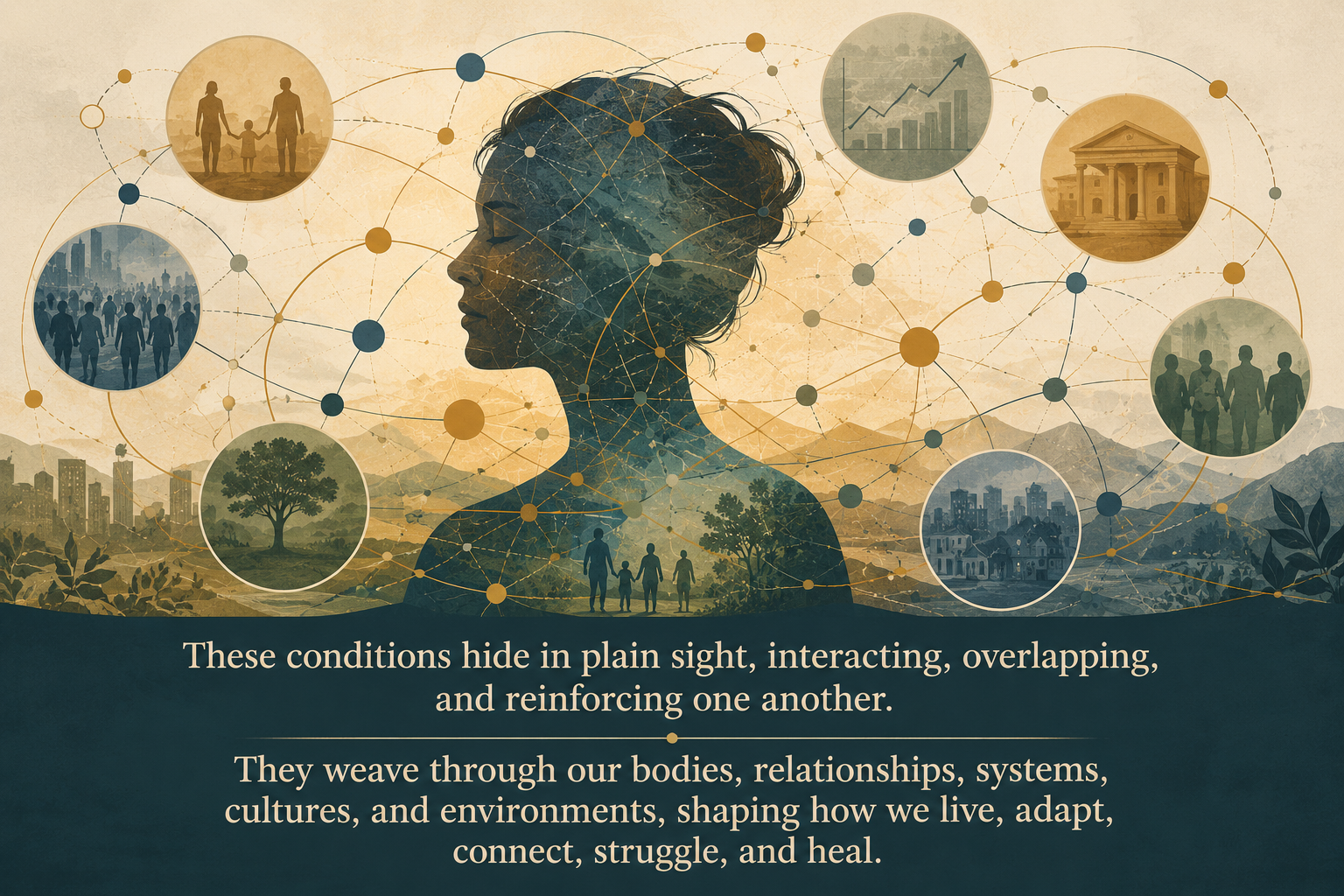
The conditions shaping our lives are deeply interconnected.
Some support balance, connection, and well-being.
Others sustain patterns of fragmentation, disconnection, and chronic imbalance.
Some are inherited. Some are learned. Some are embedded within the systems and environments we inhabit.
Together, they shape the terrain of human experience.
-
Adaptation is one of the body's most remarkable capacities.
Our nervous systems are designed to respond to changing conditions, continuously adjusting to help us navigate challenge, stress, injury, uncertainty, and threat.
When difficult conditions become chronic, the adaptations designed to help us survive can fade into the background of awareness, even as they continue to influence our health, emotions, energy, attention, and capacity for connection.
Examples include nervous system dysregulation, chronic inflammation, toxic stress, sleep disruption, and trauma-related physiological adaptations.
-
We are born into this world carrying both the wisdom and wounds of previous generations.
Their experiences, adaptations, beliefs, relationships, and stories become part of the scaffolding that shapes how we understand ourselves, relate to others, and navigate the world around us.
Some of what is passed forward becomes a source of resilience, connection, belonging, and strength. Other inheritances carry forward adaptations shaped by trauma, chronic stress, loss, displacement, oppression, and adversity.
Recognizing what has been carried forward helps us better understand the patterns, strengths, and struggles that shape our lives.
Examples include intergenerational trauma, inherited survival patterns, family narratives, cultural memory, and epigenetic influences.
-
Long before we have words for our experiences, our relationships are teaching us how the world works.
Childhood is where we first learn:
• Is the world safe?
• Can I depend on others?
• Am I worthy?
• Do my needs matter?
• Do I belong?
• Do I matter?
Those lessons become the lens we use to understand ourselves, relate to others, and navigate the world around us.
Bringing our awareness to these early lessons helps us better understand patterns that continue to shape our relationships, behaviors, beliefs, and capacity for connection throughout life.
Examples include childhood trauma, relational neglect, attachment injuries, physical, sexual, and emotional abuse, inconsistent caregiving, chronic invalidation, and disrupted attachment.
-
When culture itself is distorted, the stories we live by become harmful.
This includes ideologies that prize perfection over presence, extraction over reverence, and productivity over humanity.
It also includes spiritual frameworks that suppress emotion, glorify suffering, or bypass responsibility.
In these conditions, harm is normalized, and healing becomes taboo.
Examples include: hyper-individualism, spiritual bypassing, and productivity as self-worth.
-
Not all suffering is private. Many forms of disconnection are designed into the systems we live within.
Racism, poverty, homophobia, ableism, colonization, and other forms of identity-based oppression create structural barriers to safety, health, and dignity.
These are engineered conditions that reproduce imbalance at scale.
Examples include: racism, poverty, marginalization, and historical erasure.
-
Our disconnection from the Earth and its natural rhythms has profound consequences.
Pollution, habitat destruction, food insecurity, climate collapse, and overexposure to artificial environments, including screens, noise, and EMFs, contribute to nervous system overload, illness, and a loss of ecological belonging.
We are not designed to live cut off from the land and natural life. Our very survival depends upon our reciprocal relationship with the planet and ecosystem members which sustains us.
Examples include: pollution, ecological collapse, digital overwhelm, disconnection from land and natural cycles.